By
ByImagine a world where your house and your car aren’t just separate tools of everyday life, but parts of the same energy ecosystem. A world where your vehicle powers your home, your home charges your vehicle, and both are created layer by layer by a 3D printer. This isn’t science fiction. It’s already happening.
Architectural giant SOM, in collaboration with the University of Tennessee and researchers from the U.S. Department of Energy’s Oak Ridge National Laboratory, has unveiled a groundbreaking concept that blurs the line between housing, mobility, and energy independence. The project is called AMIE 1.0—short for Additive Manufacturing Integrated Energy Structure—, and it represents a bold glimpse into the future of off-grid living.
At its core, AMIE 1.0 is a 3D-printed tiny house paired with a 3D-printed SUV. But the real innovation lies in how these two structures interact. The car isn’t just transportation, it’s an active part of the home’s energy system. Together, the house and vehicle generate, store, and share electricity in a tightly integrated loop.
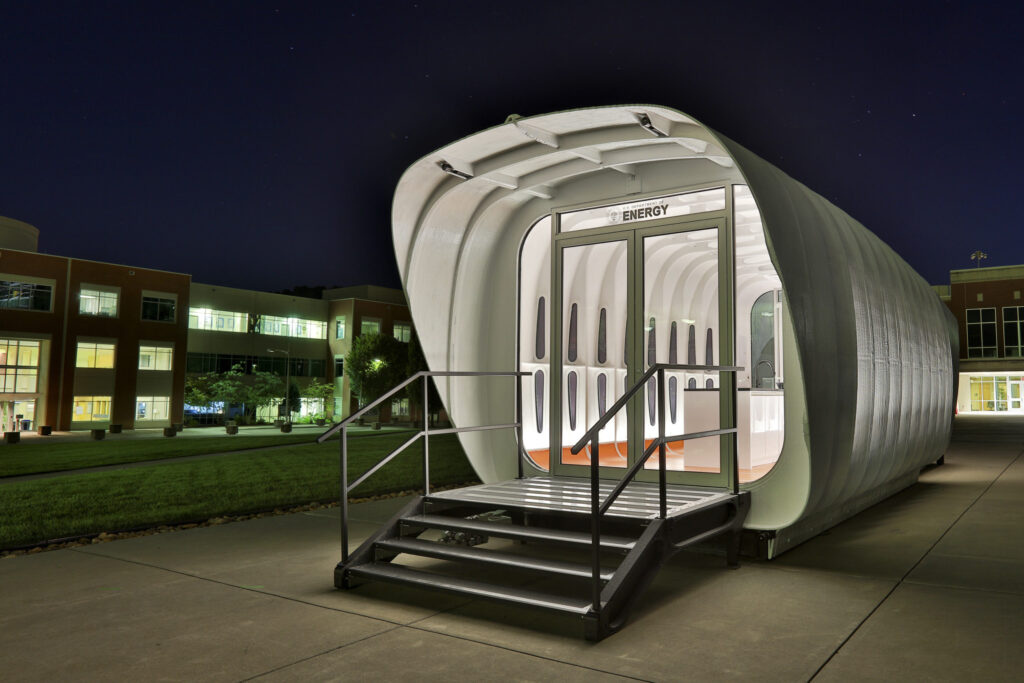
The tiny home itself is a sleek, futuristic structure printed from carbon-fiber-reinforced ABS plastic. While this material may not yet be the pinnacle of sustainability, it offers exceptional strength and durability. The home was printed in modular sections, then assembled and reinforced with steel rods, resulting in a rigid, highly insulated structure. Advanced insulation panels help maintain internal temperatures efficiently, making the house well-suited for off-grid environments.
What truly sets AMIE 1.0 apart, however, is its bi-directional energy system. The house and SUV are connected through a 6.6 kW integrated energy network, managed by smart computer algorithms. Energy flows wirelessly between the two: the solar-powered home can charge the vehicle, and the vehicle can send power back to the house when needed.

The SUV itself is a hybrid, running on both electricity and natural gas. When parked, it sits atop an inductive charging pad, allowing seamless energy transfer without physical cables. And for backup, the house can still connect to the grid—ensuring reliability even when renewable sources are temporarily unavailable.
Perhaps most impressive is how quickly this vision became reality. The team completed the first working prototype in just about a year, thanks largely to the speed and efficiency of additive manufacturing. And this is only the beginning. Work is already underway on a second-generation version, with plans to explore biofuels, hydrogen fuel cells, and flow batteries as alternative power sources.
AMIE 1.0 isn’t just a clever experiment—it’s a signal of where off-grid living is headed. As 3D printing technology matures and sustainable energy systems evolve, homes that are fast to build, low in waste, and deeply integrated with smart mobility may soon become part of everyday life.
The future of housing may not arrive brick by brick, but layer by layer.